Learn more in our complete guide: Explore all Relief & Self-Care sciatica resources →
Medical Disclaimer
Nerve Glide Exercises for Sciatica: What They Are and How They Help
Key Takeaways
- Nerve glides (neural mobilization exercises) gently mobilize the sciatic nerve within its surrounding tissues.
- They help reduce neural adhesions, improve nerve mobility, and decrease hypersensitivity.
- Start gently — nerve glides should produce mild sensation at most, never sharp pain.
- Best results come when nerve glides are part of a supervised physical therapy program.
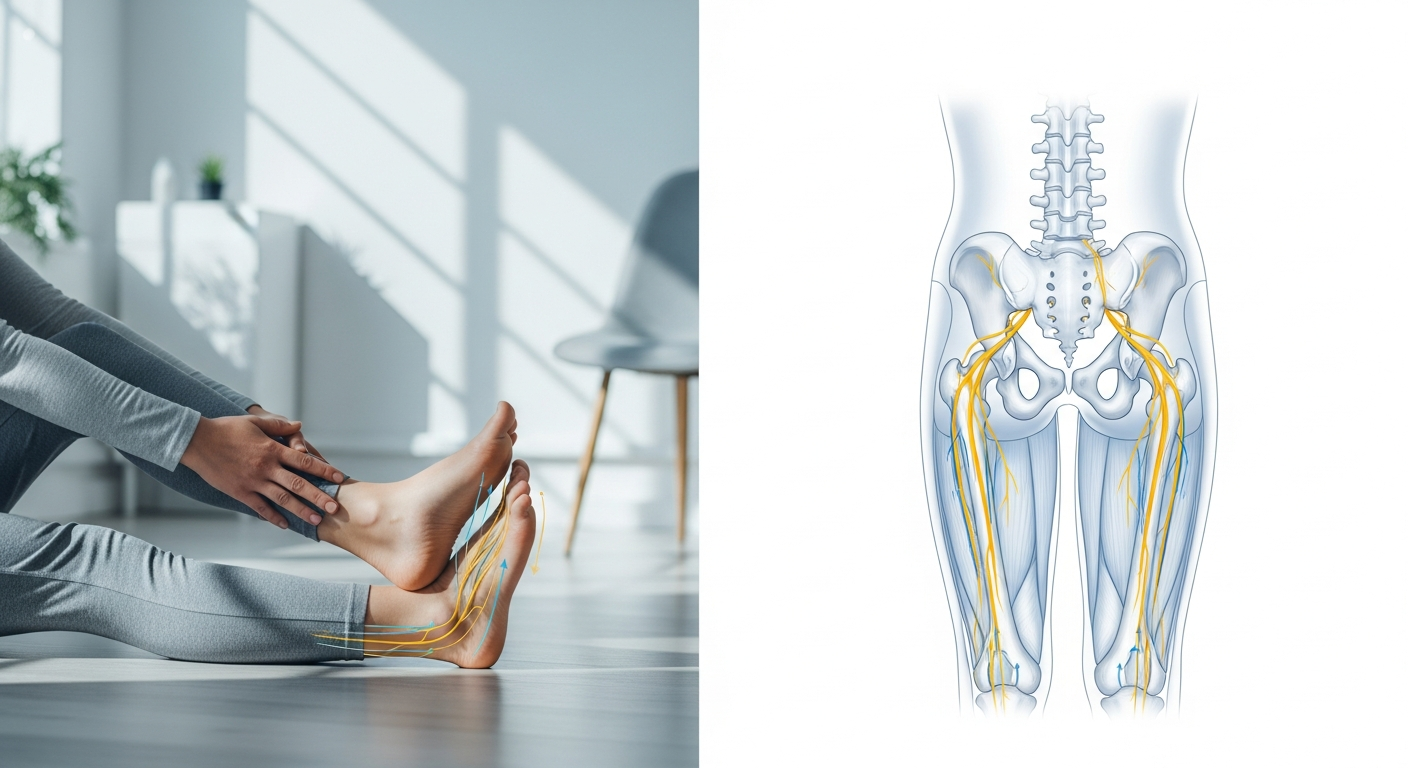
When the sciatic nerve is compressed or irritated, it doesn't just transmit pain signals — it can also become physically restricted in its movement through surrounding tissues. Normally, nerves glide smoothly through the body as you move. When inflammation, scar tissue, or compression restricts this gliding motion, movement becomes painful and the nerve may become chronically sensitized. Nerve glide exercises — also called neural mobilization or sciatic nerve flossing — are designed to restore this normal nerve mobility.
The Science Behind Neural Mobilization
The sciatic nerve must be able to elongate and slide within its surrounding connective tissue as the limb moves. For example, when you bend forward and lift your leg, the sciatic nerve elongates by several centimeters. When irritation, inflammation, or previous injury creates adhesions (areas of abnormal tissue binding), this gliding is restricted.
Neural mobilization techniques work by:
- Physically mobilizing the nerve along its pathway, breaking down mild adhesions
- Promoting circulation and fluid exchange within the nerve's connective tissue sheath
- Reducing mechanical sensitization of the nerve (desensitizing it to movement)
- Improving the nerve's ability to tolerate the normal mechanical demands of movement
Important Safety Guidelines
Before starting nerve glides: These exercises should ideally be introduced and guided by a qualified physiotherapist, especially in the early stages of sciatica. Nerve glides should produce mild stretching sensation — possibly a slight pulling, tingling, or mild discomfort — but should never produce sharp, worsening pain or significantly increased radiating leg pain. If any exercise causes worsening symptoms, stop immediately.
Sciatic Nerve Glide #1: Supine Sciatic Nerve Glide
This is the gentlest starting point for most people.
Starting position: Lie on your back.
Movement:
- Bend your hip and knee on the affected side to 90° each (thigh vertical, shin horizontal)
- Gently extend your knee (straighten the leg) until you feel mild tension or pulling in the back of the leg — stop before pain
- Hold 3-5 seconds
- Return to starting position
- Repeat 10-15 times
This is a nerve glide (slider) — the nerve moves but tension is kept relatively low.
Sciatic Nerve Glide #2: Seated Sciatic Nerve Floss
This is slightly more advanced — appropriate for subacute or chronic sciatica.
Starting position: Sit upright in a chair.
Movement:
- Straighten your knee on the affected side (leg extends forward)
- Simultaneously extend your neck backward (look up)
- Then bend your knee back down and lower your head forward (tuck your chin)
- These movements are performed simultaneously and rhythmically
- Repeat 10-15 times in a gentle, flowing manner
When knee extends, the sciatic nerve is tensioned distally; when neck extends, it's tensioned proximally — the two tension points alternating creates a "flossing" action.
Sciatic Nerve Glide #3: Standing Nerve Glide
This functional position is suitable for those with mild symptoms who can stand comfortably.
Starting position: Stand near a wall for balance if needed.
Movement:
- Extend one leg forward, resting the heel on a low surface or just on the floor in front
- Keeping the knee straight, gently flex your foot (toes toward you) while simultaneously bending your neck forward (looking down)
- Then relax the foot and look up
- Repeat 10-15 times slowly and rhythmically
Progression and Frequency
Begin with the gentlest variation (supine) once daily, 10 repetitions. If you experience only mild, brief sensitivity that resolves within 24 hours, gradually progress to 15 repetitions and twice daily. Progress to more advanced variations only when simpler ones are completely comfortable. Most patients see improvement over 4-8 weeks of consistent practice.
When to Seek Medical Care
If nerve glides consistently worsen your symptoms, or if you develop new neurological symptoms (increased weakness, new areas of numbness), seek physical therapy guidance. For assessment and a personalized neural mobilization program, consult a physiotherapist with training in neurodynamics.
Medically reviewed for accuracy. Last updated: March 2026.
Frequently Asked Questions
Related Articles
Recommended Next Steps
Understanding treatment pathways can help guide your relief decisions.