Learn more in our complete guide: Explore all Causes sciatica resources →
Medical Disclaimer
Heavy Lifting and Sciatica: Risk, Prevention, and Safe Techniques
Key Takeaways
- Improper heavy lifting is a leading cause of lumbar disc herniation, the #1 cause of sciatica.
- The combination of heavy load plus spinal flexion plus rotation is the most dangerous lifting position.
- Proper lifting mechanics and core strength training dramatically reduce sciatica risk.
- Workers in physically demanding jobs face elevated lifetime sciatica risk.
For millions of workers — nurses, warehouse workers, construction laborers, movers, and athletes — heavy lifting is an unavoidable part of daily life. The lumbar spine is remarkably strong and well-designed for physical work, but it has limits. When those limits are exceeded — whether through excessive load, poor technique, fatigue, or cumulative wear — the result can be a herniated disc and the searing sciatic nerve pain that follows.
Why Heavy Lifting Stresses the Lumbar Spine
The lumbar vertebrae and discs are under constant compressive force during upright activity. Even standing applies about 100kg of force on the L3 disc. When you lift a heavy object, particularly with the spine bent forward, these forces multiply dramatically — studies have measured forces exceeding 3,000 kg on the lumbar spine during heavy lifting activities.
The lumbar intervertebral discs absorb and distribute these forces. The annulus fibrosus (the tough outer ring) resists the centrifugal pressure trying to push the nucleus pulposus (the inner gel) outward. When forces exceed the annulus's structural capacity — especially when it is already weakened by age or prior micro-damage — a tear occurs and disc material herniates into the spinal canal, compressing the sciatic nerve roots.
The Most Dangerous Lifting Positions
Not all lifting is equal in its risk. The combination of several factors dramatically increases the probability of disc injury:
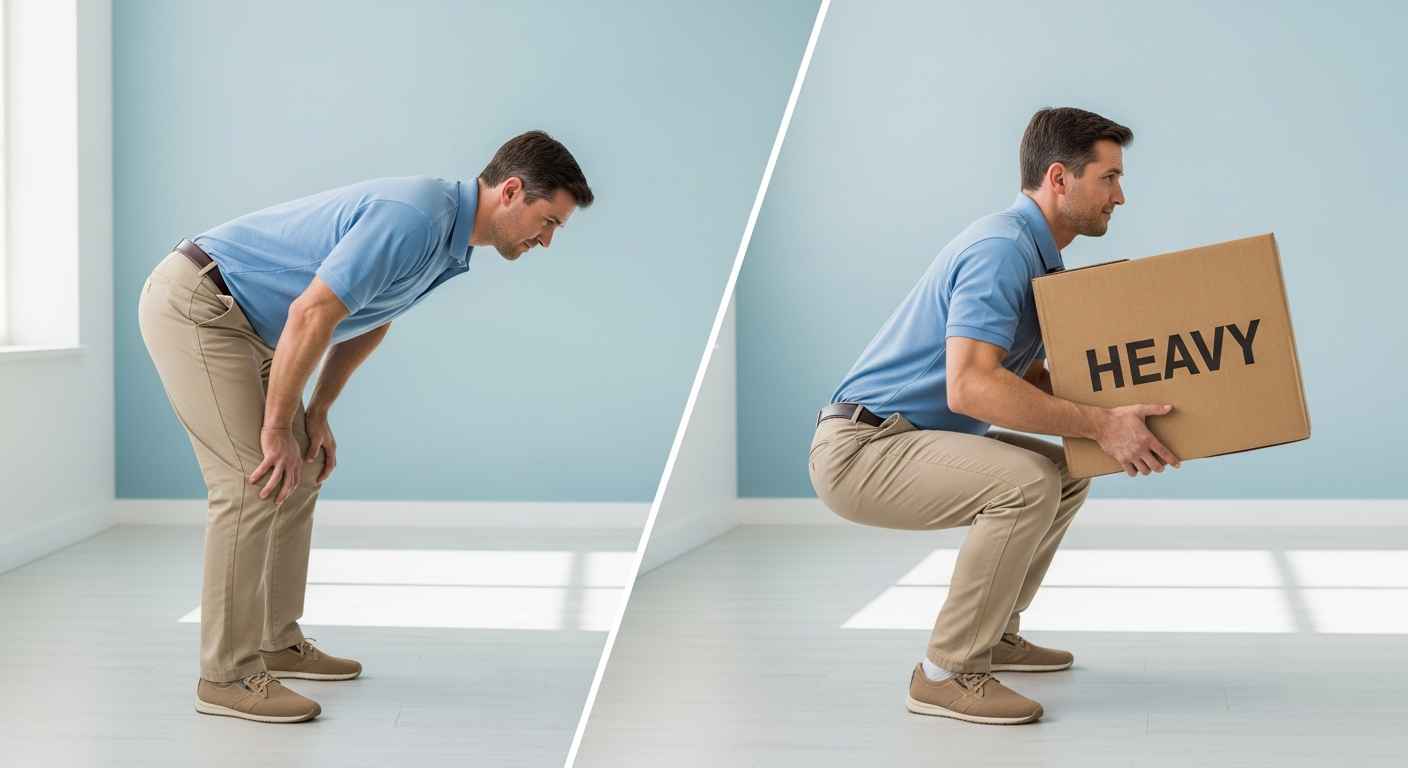
- Spinal flexion: Bending forward at the waist (rather than squatting) increases disc pressure significantly, particularly in the posterior disc — exactly where herniations typically occur.
- Rotation: Twisting the spine while lifting multiplies shear forces on the annulus fibrosus, dramatically increasing tear risk.
- Heavy load: Greater weight equals greater compressive force on the disc.
- Fatigue: Tired muscles stabilize the spine less effectively, shifting more force directly onto the discs.
- Distance from body: Holding an object far from the body (a long lever arm) exponentially increases forces at the lumbar spine.
Occupational Risk
Workers who regularly perform heavy lifting have significantly higher lifetime rates of lumbar disc herniation and sciatica. High-risk occupations include:
- Nursing and healthcare (patient transfers and repositioning)
- Construction and heavy industry
- Warehouse and logistics work
- Agriculture
- Moving and freight
Cumulative exposure over years and decades magnifies risk. A single heavy lift may not cause injury, but thousands of repetitions with suboptimal technique create cumulative micro-damage that eventually leads to disc failure.
Safe Lifting Principles
The fundamentals of safe lifting have been well-established through occupational health research:
- Plan the lift: Before lifting, assess the weight and plan your path. Get help or use equipment for very heavy objects.
- Position your feet: Stand with feet shoulder-width apart, as close to the load as possible.
- Bend at the hips and knees: Squat down to the load — do not bend at the waist.
- Keep your back straight: Maintain a neutral spinal curve. A slight arch in the lower back is protective, not harmful.
- Engage your core: Brace your abdominal muscles before and throughout the lift.
- Keep the load close: Hold objects as close to your body as possible.
- Lift with your legs: Push through your heels and straighten your hips and knees to rise.
- No twisting: To change direction, pivot your feet — don't rotate your spine while carrying a load.
- Lower the same way: Reverse the process when setting down the load.
Core Strength: Your Spine's Best Defense
The muscles of the trunk — the deep core muscles including the transversus abdominis, multifidus, and diaphragm — act as a natural internal brace for the lumbar spine during lifting. Strong, well-conditioned core muscles reduce the load on spinal discs by sharing the forces involved in lifting activity. A physical therapy program that emphasizes core strengthening is one of the most effective long-term strategies for reducing sciatica risk in people who must lift regularly.
When to Seek Medical Care
If you experience sudden, severe back pain with leg numbness or weakness after heavy lifting, seek medical evaluation promptly. Symptoms of cauda equina syndrome — including loss of bladder or bowel control — require immediate emergency care.
Medically reviewed for accuracy. Last updated: March 2026.
Frequently Asked Questions
Related Articles
Recommended Next Steps
Understanding treatment pathways can help guide your relief decisions.