Learn more in our complete guide: Explore all Causes sciatica resources →
Medical Disclaimer
Degenerative Disc Disease and Sciatica
Key Takeaways
- Degenerative Disc Disease (DDD) is not actually a disease, but a natural condition of aging.
- As discs lose water and shrink, they provide less cushioning between vertebrae.
- This shrinkage can reduce the space for nerve roots to exit, causing sciatica.
- DDD also makes the discs more prone to tearing and herniation.
The term "Degenerative Disc Disease" (DDD) sounds alarming, but it is actually a misnomer. It is not a disease at all, but rather the medical term for the natural, expected wear-and-tear process that happens to spinal discs as we age. While everyone experiences some degree of disc degeneration, for some, this process causes significant lower back pain and can trigger sciatica.
What Happens During Disc Degeneration?
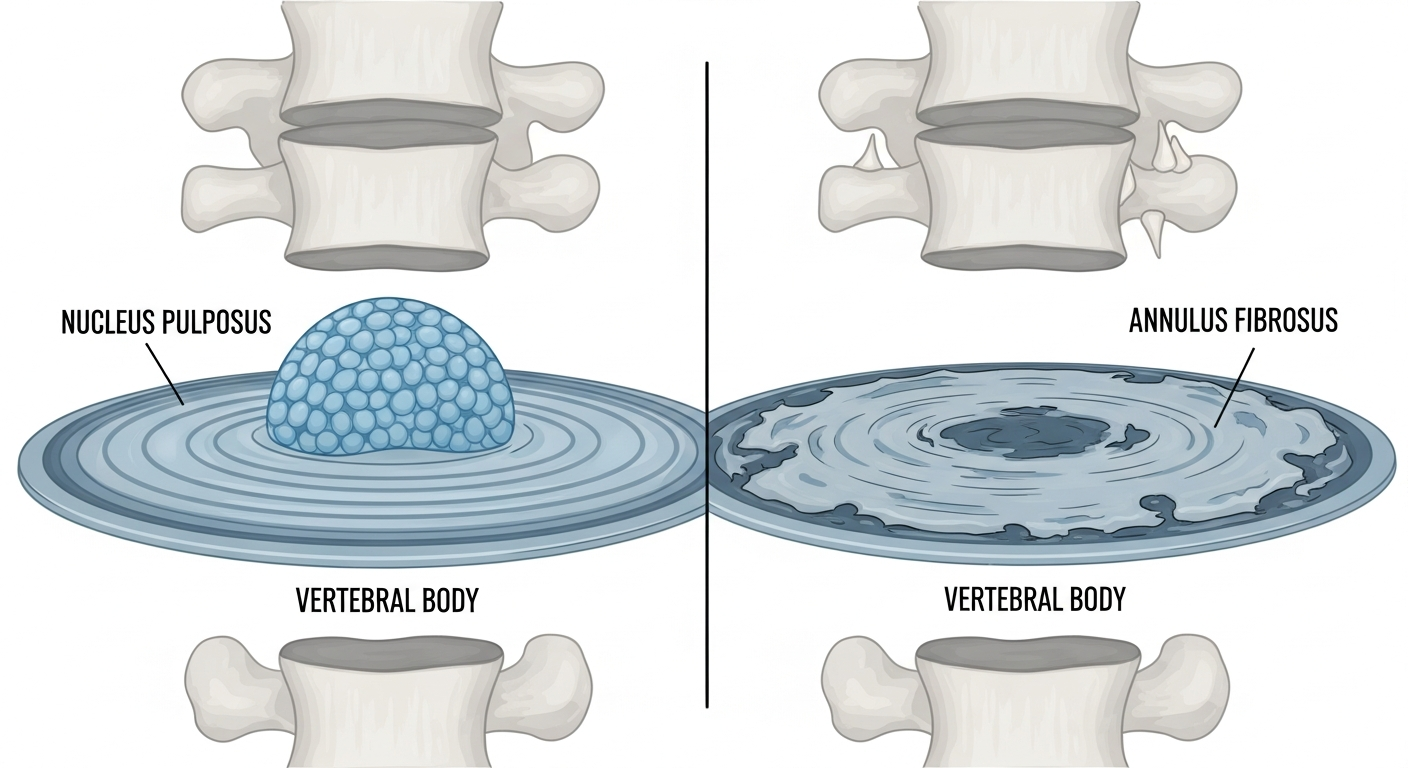
When you are young, your spinal discs are plump, flexible, and filled with fluid—mostly water. This high water content allows them to act as effective shock absorbers between the bony vertebrae of your spine.
As part of the normal aging process, several changes occur:
- Loss of Hydration: The discs gradually lose their water content. They become thinner, flatter, and less capable of absorbing shock.
- Micro-Tears: The tough outer layer of the disc (the annulus) accumulates tiny tears from daily movement and stress.
- Loss of Disc Height: As the discs flatten out, the distance between the vertebrae shrinks.
How DDD Causes Sciatica
Degenerative disc disease creates a chain reaction in the spine that can ultimately compress the sciatic nerve. This happens in a few ways:
- Foraminal Narrowing: The sciatic nerve roots exit the spine through small bony openings called foramina. When a disc loses its height and flattens out, the space between the vertebrae collapses. This physically shrinks the size of the foramina, pinching the exiting nerve root.
- Increased Risk of Herniation: Because degenerated discs are weaker and have micro-tears in their outer walls, they are much more susceptible to bulging or fully herniating, which directly compresses the nerve.
- Bone Spurs: The loss of disc cushioning causes the vertebrae to rub together. The body attempts to stabilize this abnormal movement by growing new bone (bone spurs), which can intrude into the spinal canal and compress nerves.
Symptoms of Sciatica Caused by DDD
In addition to the standard radiating leg pain of sciatica, patients with underlying DDD often experience:
- A low-grade, continuous ache in the lower back that occasionally flares up into severe pain.
- Pain that worsens when sitting, bending, or lifting, and improves slightly when walking or changing positions frequently.
- Stiffness in the lower back, especially in the morning upon waking.
When to See a Doctor
Consult a healthcare professional if your back and leg pain prevents you from performing daily activities, or if you notice progressive weakness, numbness, or tingling in your leg that does not improve with rest.
Frequently Asked Questions
Author: WhatIsSciatica.net Editorial Team
Medical Reviewer: Dr. Sarah Jenkins, MD
Last Updated: March 2024
Related Articles
How age impacts spinal health and increases the risk of sciatica.
The leading cause of sciatica, often resulting from weakened discs.
How targeted physical therapy can relieve sciatic nerve compression.
Recommended Next Steps
Understanding treatment pathways can help guide your relief decisions.